State Repression at the G20 Protests

The dust has settled: a total of 193 arrests took place during the G20—a great number of those being random bystanders. 17 people face felonies; one young person is being absurdly scapegoated for $20,000+ of damage, while two alleged participants in the comms group are being charged with “hindering apprehension or prosecution, criminal use of a communication facility, and possessing an instrument of crime,” presumably in hopes of setting a precedent to suppress the use of communications technology to keep demonstrators safe in the future.
Indeed, several people have been charged with “hindering apprehension,” which is a new one to us here. It sounds more like an existential condition than a crime—picture Woody Allen in some sex farce, awkwardly explaining to his mother that he’s been suffering from hindering apprehension!
This report focuses on the events of Friday evening, when police and National Guardsmen gratuitously attacked students at the University of Pittsburgh.
We’ve retreated to a back street; a cacophony of sirens, gunshots, and explosions echoes off the walls ahead of us. With our experience, this isn’t exactly frightening—it all seems to be happening in slow motion; but the irrationality of the authorities’ behavior is unsettling. A tremendous cloud of white smoke is filling the air above the roof of the dormitory, and a familiar acrid scent is beginning to mingle with the sweet stench of tear gas: is something on fire? Two more tear gas canisters soar high into the night sky, trails of poison billowing behind them, and land on the same roof. It’s like the Fourth of July, only with crying, bleeding college students fleeing beneath the fireworks.
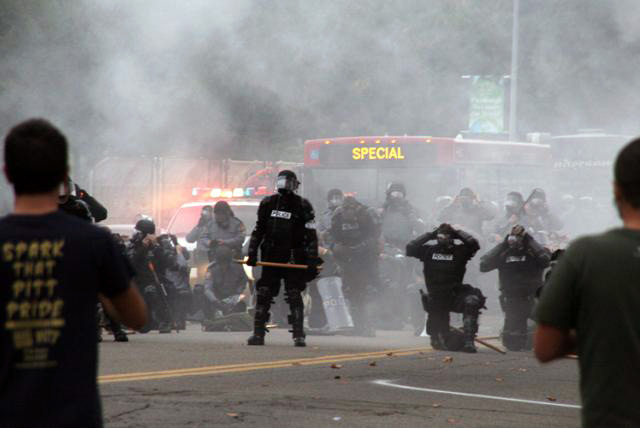
According to reports, the authorities assembled a force of nearly 5000 for the G20, including 2500 National Guard troops, 1200 state troopers, 875 Pittsburgh city police, and small groups from other agencies. It’s a potentially significant precedent that the National Guard comprised more than half of the total force; it may point to greater military involvement in domestic policing in the future. It’s also important to note that the original plan had been to utilize more police and fewer National Guard, but it appears that only the National Guard was available—one more sign of overextension among our foes.
According to Cindy Sheehan and others, the National Guard troops in Pittsburgh had recently returned from duty in Iraq. This may explain their behavior the night of Friday, September 25, when they pointlessly brutalized a gathering of students at the University of Pittsburgh in downtown Oakland.
Earlier that day, a flier had circulated reading “Go Pitt; Fuck the Police; 10 p.m., Schenley Plaza,” the location of the previous night’s standoff between police and students. By ten o’clock, hundreds of people had gathered in and around the plaza. A small minority were avowed anarchists; perhaps a greater proportion had participated somehow in the previous day’s events, but the vast majority appeared simply to be curious students.
The university had sternly instructed students to stay away from Schenley Plaza that night, but this backfired, making the Plaza irresistible. Police and National Guard were already present in the area in tremendous force, parading in full riot gear. Helicopters combing the ground with searchlights intensified the atmosphere of military occupation.
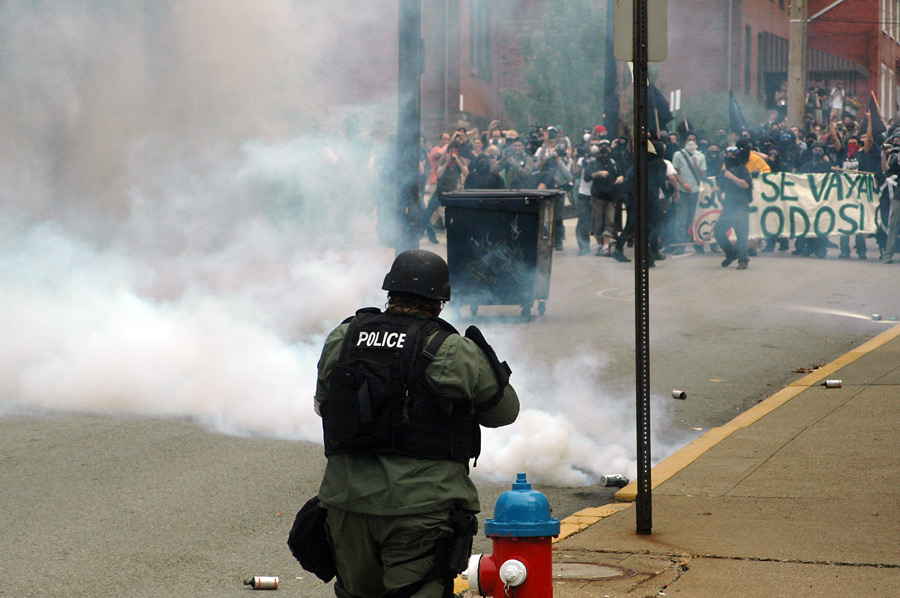
No protest ensued: no march, no banners, no chants, no confrontations or property destruction. All the same, the police soon forcibly cleared the square. Not content with this, they then began to shoot tear gas canisters at spectators on the sidewalk across the street. Eventually, they advanced further, shooting tear gas and projectiles at hapless, fleeing onlookers and beating and arresting anyone they could catch. This continued for hours; in the end, 110 people were arrested, mostly passers-by and medics who stayed behind to treat the injured. The National Guard pacified Oakland the same way they pacified neighborhoods in Iraq.
Despite years of police brutality and “Bring the War Home” rhetoric, witnessing this was downright dumbfounding. Anarchists always decry police repression, arguing that every use of coercive authority is illegitimate. But it is difficult to imagine how even a statist conservative could justify this particular exercise of repressive force; there was no resistance to repress. The events of Friday night show that the authorities can produce a “riot” simply by ordering people not to do something that they don’t even realize they are doing; this is the heavy-handed stupidity that helped generate the Iraqi resistance.
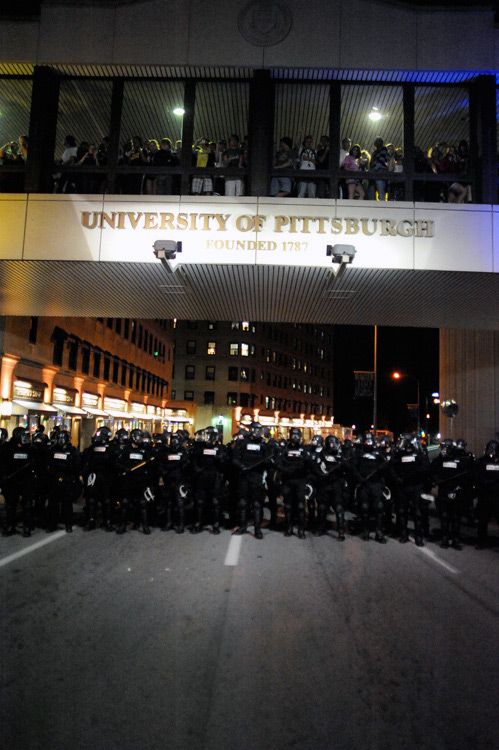
No outrage was capable of igniting resistance among the students, however. The flier had cast them as the protagonists in a struggle against the police; some radicals came hoping to support them in this conflict, their hopes buoyed by the clashes that had taken place on the same terrain the previous evening. But the students refused to see themselves as protagonists; despite 36 hours of other young people in hooded sweatshirts confronting the police, they still saw themselves as inert and helpless. This underscores the foolishness of pinning one’s hopes on another demographic as the revolutionary subject. Instead of waiting for others to take the initiative, those who wish to struggle against this society must cast themselves as protagonists in that struggle and find common cause with all who join in.
Some anarchists took the dim view that the students were carrying their apathy to a sadomasochistic extreme, paradoxically asserting their right to be spectators of their own repression: “Why are you tear-gassing us? We have the right to be here watching you tear-gas us!” Conversely, one might argue that, by being present in defiance of the decrees and threats of the university, the students were already challenging their social roles—perhaps more so than the anarchists who were just there to do what anarchists always do. In that light, simply in coming out, the students were protesters: not politicized protesters like those who elaborated their critiques of the policies of the G20 into indymedia cameras, but protesters all the same against the authority of the school administration and the tedium of college life.
For their part, though they set out to break up a presumed protest, the police had no method by which to identify protesters. They began by threatening everyone; those who did not immediately flee they assumed to be protesters. They tear-gassed everyone; those who covered their faces were obviously protesters. As they claimed territory block by block, they shot projectiles at anyone in view; those they struck were marked as protesters by their own blood. They charged anyone who remained on the street; those who ran away were protesters, and were chased, tackled, and beaten accordingly.
At one point, word went out that the police were about to raid the dormitory towers in search of protesters. Had this occurred, it would have been a bloodbath. All this illustrates how those serving authoritarian power can only see—and thus produce—enemies everywhere they look. Coercive force can never resolve conflict, only intensify it.
Following Thursday’s clashes, it turned out that a mere flier sufficed to provoke a full-scale police state. Once again, the apparatus of repression causes a great deal more disruption than the protests to which it responds: the tiny sting of the anarchist mosquito provokes an intense allergic reaction that can be disproportionately costly for the state. In some ways, the events of Friday night were strategically fortuitous for anarchists: the police discredited themselves, and this is bound to help the cases of those who were arrested on Thursday.
At the same time, it’s possible to be overly optimistic about this. Manifestations of the violence inherent in state power don’t necessarily persuade people of the possibility or value of the anarchist alternative. The police didn’t win any new friends Friday night, but nothing empowering occurred either. It will take months of serious follow-up work from Pittsburgh locals if the events of September 25 are to attract new people to anti-authoritarian struggle.
In this regard, the invisibility—dare we say the mythological character—of actual anarchists Friday night was a loss of ground. Anarchists were at once everywhere and nowhere. Everywhere—or else why were the police attacking everyone?—yet nowhere, in that there was no explicitly anarchist presence. This indeterminacy implies a tremendous potential—Are those people over there anarchists? Might I be one, myself?—but usually ends up serving the interests of the state. As the underdogs, anarchists generally have to stay in the shadows for security reasons; we can hardly speak honestly about our intentions in our own spokescouncils, let alone to the public at large. We remain utopian ghosts, shadows pursuing something otherworldly, while the police prove again and again that they are the only reality, writing this on the skin of civilians in a Morse code of rubber bullets when need be.
This is why moments of visibility and togetherness like those we experienced Thursday afternoon are so important. When enough of us join in action, we are no longer isolated lunatics pursuing will-o’-the-wisps; brought into reality, our dissident desires are legitimized in a such a way that we can finally believe in them, so that others will be able to as well. Suddenly, fighting capitalism is more realistic than knuckling under to it. Nothing makes more sense than pulling masks over our faces, linking arms, and charging our oppressors. Dumpsters cease to be organs of denial about the wastefulness of our civilization and become mobile barricades; corporate windows cease to display merchandise and sing instead the uproar of social transformation. The world itself becomes something different.
Now that the G20 protests are over, let us not retreat into obscurity, but lay the groundwork for other battles in which we can give our dreams flesh together.
[First Photo by Foo]