Archive for May, 2009

Rolling Thunder Seeks Accounts from Chile


Following the death of an anarchist alleged by corporate media to be transporting a destructive device, a wave of government repression is sweeping Chile. We extend our heartfelt condolences to those who mourn the loss of a friend, and our support to all who still suffer under a repressive apparatus that has not fundamentally changed since the reign of Pinochet. We fear the worst is yet to come, as the Chilean government will likely use this as a pretext for further raids, arrests, and harassment.

As a humble gesture of solidarity, the next issue of our biannual journal Rolling Thunder will include a report on Chilean resistance movements over the past decade; we hope this will provide more context for and awareness of the Chilean situation for readers around the world. As we did for our coverage of the Ungdomshuset and G8 protests, we are soliciting anonymous accounts from participants in the past decade of social struggles in Chile to fill out our coverage.

If you have experiences you are willing to share or can direct us to publicly available narratives, please contact us at rollingthunder@crimethinc.com. Those who have privacy concerns should consider starting a new email account on a public-access computer.

Please circulate this statement anywhere it may be relevant. Thank you.

En Español After the Jump

CrimethInc. Convergence 2009 Update

Meet at the Northside Commons (W. North Ave. and Brighton) by the pond, on Monday, July 20. Write to info@crimethincconvergence.com with workshop proposals, offers of assistance, and accessibility concerns.

A lot of water has passed under the bridge since the first CrimethInc. convergence in August 2002. We’ve witnessed a protracted war and occupation, an economic crisis, and most recently a change—however superficial—of rulers. We have come full circle from being isolated dissidents in a time of patriotic consensus to seeing our radical critique co-opted by politicians at the very moment our neighbors are becoming aware of the injustices of capitalism and empire.

Seven convergences later, we have reduced the limitless possibilities of the format we first tested to a precise science. We’re in a different social context now, and it’s time to debut a new experiment.

As the economic downturn affects the geography of urban centers, tremendous spaces are opening up that could become new sites of autonomy and struggle. This year, rather than gathering in a wilderness setting to nurture our subversive desires in seclusion, we will stage our convergence in the decaying metropolis of Pittsburgh, Pennsylvania. We hope that this event can contribute to building long-term infrastructure for our culture of resistance.

This will be nothing like the urban anarchist conferences of the past decade–no antiseptic university setting, no dispersing to isolation in individual meals and housing at the end of the scheduled programming. We will actively contest the city environment in an effort leave a permanent mark upon it, just as we hope to contest the rituals and informal hierarchies of the anarchist milieu.

All spring, rumors have circulated about the secret plans of the contingent in Pittsburgh organizing this event. What’s this about squatting a castle? Is it true that they’re buying a giant warehouse in the city center? Will we be building a hammock village spread across empty lots? There aren’t actually catacombs in Pittsburgh, are there?

We’ll have more news here shortly. In the meantime, here are fliers announcing the event {2-up Handbill [2.6MB] & Full-page Flyer [2.4MB]}–please disseminate them everywhere you can. There also a rudimentary website at www.crimethincconvergence.com, which will be expanded soon.

Finally, here are the policies for this summer’s convergence, which have been thoughtfully revised by the locals bottomlining the event. If you are frustrated about any of them, please organize your own event!

Policies after the jump.

2008 DNC/RNC Mobilizations: Full Report


At long last, we’ve completed our 35,000-word full report on last summer’s anarchist mobilizations against the Democratic and Republican National Conventions, complete with chronological maps and painstaking documentation. Updated from the feature in Rolling Thunder #7 and expanded to include the complete text of thirteen different participant narratives, this report offers a comprehensive history of the preparations for, events of, and aftermath following the protests, and an analysis of their context and implications.

Unlike virtually every other analysis yet published from the radical community, this one utilizes subsequent internal government reports, comparing them against a wide variety of other sources. We hope our investigation and the accompanying archive of personal testimonies will prove useful both to participants still trying to understand the events of this past summer and to organizers looking to derive lessons from them for the future.

In a nutshell, we hypothesize that the chief significance of the 2008 anti-convention mobilizations was in the precedents they might set for future organizing. Anarchists took the initiative to determine their own goals and strategies for the protests, establishing decentralized networks throughout the US far in advance. This enabled them to build relationships with other organizing groups and to coordinate their actions, effectively setting the tone for the protests at both conventions. At the same time, the protests were less attended than expected, perhaps as a result of the Obama campaign detracting from street-level participation in the antiwar movement. In this regard, they were the final act of an era that has now passed.

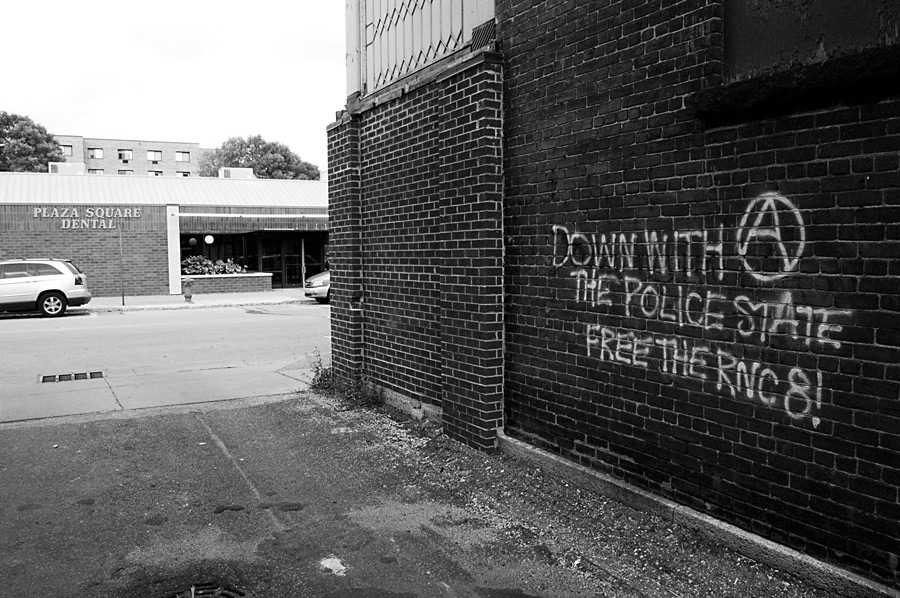
The RNC protests met with an almost unprecedented degree of state repression, which is still playing out today even as the political climate has changed. The federal government continued its strategy of gathering intelligence and entrapping stragglers, already familiar from attacks on environmentalists and animal rights activists. Local authorities focused on infiltration, profiling, and raids, ultimately arresting over 800 people and bringing conspiracy charges against organizers. Despite all this, they seem to have been remarkably unprepared to maintain order in the streets on the first day of the RNC, and their subsequent overreaction helped discredit them in the public eye. Most arrestees have gotten off scot-free; it remains to be seen how the ongoing felony cases will conclude. The outcome of the RNC 8 conspiracy trial in particular will indicate how sustainable we can expect the organizing model debuted at the 2008 conventions to be.

Going It Alone: Anarchist Action at the Democratic 
and Republican National Conventions

We Are All Legal Workers: Legal Support at the RNC and After

Accounts from the Democratic 
and Republican National Conventions