Babel, Children of Men, and Pan’s Labyrinth

At base, these three Hollywood movies by Mexican directors share the same chilling fixations and questions. All three derive their edge from focusing on grievous threats to children while dwelling upon whether adult humanity deserves to—or even can—survive its self-inflicted catastrophes.
Babel, like Amores Perros before it, is a long, grim meditation on guilt and penitence. The characters begin in personal Edens, oblivious to the weight and danger of each moment. These Edens are far from idyllic—they range from banal to tormented—but the calamities that shatter them make them seem blissful by comparison. Tragedies result inexorably from seemingly trivial decisions, ultimately humbling all the characters before their immense responsibilities to one another. Of the three movies, the greatest number of protagonists remain alive at the conclusion of Babel—not because it ends more happily than the other movies, but because in this secular fable they must be alive in order to serve their time in hell.
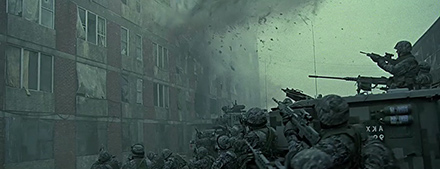
Speaking of hell—the thing that makes Children of Men, a near-future dystopia, so horrifying is that dystopias are never predictions of the future so much as reflections of the present. Forget what the world will be like in 2027—this blood-curdling nightmare is simply Lebanon, Guantanamo Bay, and the US-Mexico border brought to the silver screen, an animated version of the everyday newspaper headlines of 2006. Midway through the lengthy tracking shot in which the movie descends to the deepest circle of inferno, four spots of blood land upon the camera lens and remain there. One would think this would undermine the suspension of disbelief on which Hollywood cinema rests—but instead these drops of blood invoke the real-life video most viewers are already familiar with, if not desensitized to, from internet pornography, disaster reporting, and footage of war and terrorist attacks.
Like dystopias, fairy tales are not about the world of make-believe, but the deepest, realest level of daily life. Accordingly, the fantasy plane of Pan’s Labyrinth is frighteningly inflected by the brutality and treachery of adult reality. The viewer would like to see the young protagonist retreat from her difficult situation into a sheltering dreamland, but the denizens of that dreamland appear untrustworthy at best and carnivorous at worst.
Children of Men takes a dim view of revolutionary solutions—they’re just one more excuse to kill and die1—but Pan’s Labyrinth courageously takes a stand in favor of them, investing its portrayal of the shabby remainder of the anarchist forces of the Spanish Civil War with sympathy and respect. At the end, the movie unequivocally concludes in favor of violence as a response to oppression and tyranny. It’s hard to imagine a similar message from any director from the United States, in which totalitarian slaughter of “the bad guys” is glorified while holier-than-though pacifism is palmed off as the only acceptable expression of opposition to authority.
It isn’t lost on me that these movies were finished in the same period that full-fledged revolt erupted in Oaxaca. The uniformed murderers of Pan’s Labyrinth represent the same mercenaries that killed Brad Will and dozens of Mexican freedom fighters last fall, and the bullets aimed at them by the director imply a call for concrete resistance outside the theater that too many US viewers will miss. I fear most moviegoers north of the Mexican border don’t know what the Spanish Civil War was, or that anarchists played such an important role in it, or that the fascist dictatorship that slaughtered them and that generation’s last chance for freedom was eventually supported by the United States government as well as Adolf Hitler. I hope the ones who do know these things don’t stop at just knowing them, or at watching movies.
-
Your humble reviewer was particularly affronted by the filmmaker’s choice to depict the most amoral and vicious of the terrorists as a white, dreadlocked youth most moviegoers in the United States and Europe will instantly read as a tree-hugging Earth First!-type. The message is clear—those kids may seem idealistic and well-meaning, but they’re really just hooligans ready to shed innocent blood at the service of the first ideology that presents itself. ↩